
Finding the best Korean sunscreen for oily skin isn’t simply about choosing the highest SPF. The right sunscreen should provide strong UV protection while feeling comfortable enough to wear every day without leaving your skin excessively greasy or uncomfortable.
Korean sunscreens are particularly popular for their lightweight textures, skincare-focused formulas, and cosmetic finishes.
But not every Korean sunscreen is equally suited to oily skin. If you’re not sure whether your skin is actually oily or combination, our guide on how to tell what skin type you are can help you identify the characteristics to look for before choosing your routine.
For this guide, we compared six Korean sunscreens based on texture, finish, hydration, formula characteristics, UV protection, makeup compatibility, and suitability for different types of oily and combination skin.
Quick Picks: Best Korean Sunscreens for Oily Skin
Rank | Sunscreen | Best For | Finish | Texture |
1 | Oily, combination & dehydrated skin | Dewy/natural | Serum-like | |
2 | Less shine | Velvet/semi-matte | Airy cream | |
3 | Lightweight texture | Natural/radiant | Watery cream | |
4 | Oily skin that prefers hydration | Natural/dewy | Lightweight cream | |
5 | ma:nyo Air Light Moisturizing Sunscreen SPF50 | Uneven-looking skin tone | Lightweight | Moisturizing cream |
6 | Everyday wear & makeup | Glowy | Lightweight lotion |
Quick answer
The best overall Korean sunscreen for oily or combination skin is SKIN1004 Madagascar Centella Hyalu-Cica Water-Fit Sun Serum SPF50+ PA++++ if you want lightweight hydration and don’t mind a dewy finish.
If your priority is reducing the appearance of shine, Haruharu WONDER Black Rice Moisture Airyfit is the stronger choice because the brand describes it as lightweight with a non-greasy, velvety finish.
If you mainly dislike the heavy feeling of traditional sunscreen, TOCOBO Bio Watery Sun Cream is worth considering for its lightweight, watery texture.
The important distinction is that oily skin does not automatically mean you need a matte sunscreen. If your skin is oily but also feels tight or dehydrated, a lightweight sunscreen with a natural or dewy finish may be more comfortable.
How We Chose These Korean Sunscreens
There is no single sunscreen that is best for every oily skin type. Someone with very oily skin who wants to minimize shine may prefer a completely different formula from someone with oily, dehydrated skin.
We compared the six sunscreens using seven criteria:
1. Texture
Lightweight serum, watery, lotion, and fluid textures can be more comfortable for oily skin than richer creams.
Texture is subjective, however. A formula that feels weightless to one person may feel too moisturizing to another.
2. Finish
Finish is particularly important when choosing sunscreen for oily skin.
Common finishes include:
- Matte
- Semi-matte
- Natural
- Dewy
- Glowy
We considered how each sunscreen’s published finish matches different oily-skin preferences rather than treating matte as automatically better.
3. Hydration
Oily skin can still become dehydrated. A sunscreen that provides comfortable hydration may be easier to wear consistently than one that leaves the skin feeling dry or tight.
4. Makeup compatibility
For people who wear makeup, we considered characteristics such as pilling, excessive shine, texture, and how the manufacturer positions the product for use under makeup.
5. Formula characteristics
We considered ingredients and formula features highlighted by the manufacturers, including ingredients such as niacinamide, centella asiatica, hyaluronic acid, panthenol, ceramides, and fermented extracts.
The presence of an ingredient does not guarantee a particular result. Ingredient concentration, the complete formulation, and individual skin response all matter.
6. UV protection
All six products are marketed with SPF50 or SPF50+ protection, with several carrying a PA++++ rating.
When choosing sunscreen, the AAD recommends SPF30 or higher and broad-spectrum protection. For oily or acne-prone skin, it also recommends looking for products labeled non-comedogenic or “won’t clog pores.”
7. Different types of oily skin
“Oily skin” isn’t one category. You may have oily skin with excessive shine, oily and dehydrated skin, combination skin, or oily skin that’s prone to clogged pores and breakouts.
If you’re unsure whether you’re oily or combination, see our guide on how to tell what skin type you are. That’s why our ranking includes different winners for different needs.
Best Korean Sunscreens for Oily Skin
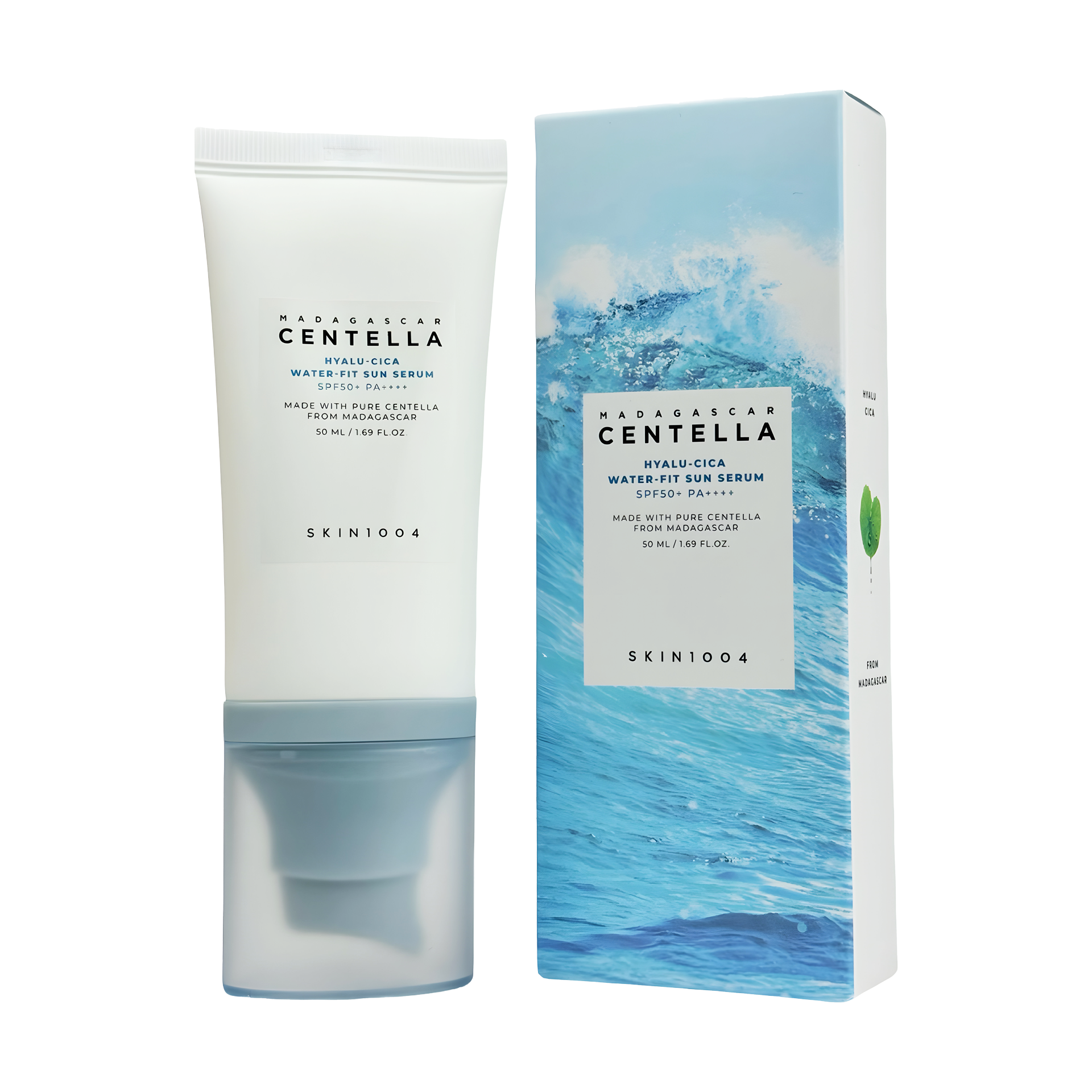
1. SKIN1004 Madagascar Centella Hyalu-Cica Water-Fit Sun Serum SPF50+ PA++++
Best for: Oily, combination, and dehydrated skin
Finish: Dewy/natural
Texture: Lightweight, serum-like cream
UV protection: SPF50+ PA++++
Why it’s our best overall pick
SKIN1004 Hyalu-Cica Water-Fit Sun Serum is a strong choice if you want a lightweight sunscreen with a skincare-like texture and don’t mind a dewy finish.
The formula includes centella asiatica, niacinamide, glycerin, and hyaluronic acid ingredients. Current product information describes it as an SPF50+ PA++++ sunscreen with a lightweight, hydrating finish.
Its biggest advantage for oily skin is comfort rather than oil control.
If your main concern is midday shine, this may not be the best choice because its dewy finish can look more luminous on very oily skin. If your skin is oily but also feels dehydrated, however, that same finish can be a benefit.
Pros
- Lightweight, serum-like texture
- SPF50+ PA++++
- Dewy, hydrated finish
- Contains centella asiatica and niacinamide
- Includes hydrating ingredients
- Good option for oily or combination skin that feels dehydrated
Cons
- Dewy finish may look shiny on very oily skin
- Not the best choice if you specifically want a matte finish
Best for: Choose SKIN1004 if you want lightweight daily SPF with hydration and prefer a natural-to-dewy finish.
2. Haruharu WONDER Black Rice Moisture Airyfit Daily Sunscreen SPF50+ PA++++
Best for: Oily skin that prefers a less shiny finish
Finish: Velvet/semi-matte
Texture: Lightweight cream
UV protection: SPF50+ PA++++
Why it’s a strong choice for oily skin
Haruharu WONDER Airyfit stands out because its published positioning is different from many dewy Korean sun serums.
The brand describes the sunscreen as lightweight and non-greasy with a velvety finish. Its formula also includes black rice-derived ingredients, hyaluronic acid, ceramides, adenosine, and niacinamide.
That makes it a particularly useful option if you want Korean sunscreen but don’t want an obviously glossy finish.
Pros
- Velvet/semi-matte finish
- Lightweight texture
- SPF50+ PA++++
- No-white-cast positioning from the manufacturer
- Contains moisturizing and skin-conditioning ingredients
- Better suited to people who dislike very dewy sunscreen
Cons
- It is not a dedicated oil-control treatment
- The moisturizing finish may still feel too rich for some very oily skin types
- Always check the current ingredient list if you are sensitive to particular ingredients
Best for: Choose Haruharu WONDER Airyfit if minimizing visible shine matters more to you than achieving a dewy finish.
3. TOCOBO Bio Watery Sun Cream SPF50+ PA++++
Best for: People who dislike heavy sunscreen textures
Finish: Natural to radiant
Texture: Watery cream
UV protection: SPF50+ PA++++
Why it’s worth considering
TOCOBO Bio Watery Sun Cream is designed around a lightweight, watery cream texture.
For oily skin, its main advantage is cosmetic comfort. Rather than choosing it because you expect it to control oil, choose it if thick sunscreen formulas are the main reason you struggle to apply SPF consistently.
Pros
- Lightweight watery texture
- SPF50+ PA++++
- Easy to spread
- Comfortable option for people who dislike thick sunscreen
- Natural-to-radiant finish
Cons
- Not specifically an oil-control sunscreen
- May look too radiant for very oily skin
- Check the current ingredient list if you are sensitive to fragrance or botanical ingredients
Best for: Choose TOCOBO if your biggest sunscreen complaint is that traditional formulas feel heavy.
4. mixsoon Bean Sunscreen SPF50
Best for: Oily skin that still wants hydration
Finish: Natural/dewy
Texture: Lightweight cream
UV protection: SPF50
Why it stands out
mixsoon Bean Sunscreen is a reasonable middle-ground option for oily skin that can also feel dehydrated.
Rather than choosing it because you expect it to “control oil,” it makes more sense to choose it if you want daily SPF with a comfortable, hydration-focused feel.
Pros
- SPF50
- Lightweight daily texture
- Comfortable option for oily/dehydrated skin
- Fits naturally into a hydration-focused routine
- No-white-cast positioning from the manufacturer
Cons
- Not designed specifically for a matte finish
- May not suit people whose main priority is reducing shine
Best for: Choose Mixsoon Bean Sunscreen if your skin is oily but tends to feel tight or uncomfortable with strongly mattifying products.
5. ma:nyo Air Light Moisturizing Sunscreen SPF50
Best for: Oily and combination skin concerned with uneven-looking skin tone
Finish: Lightweight
Texture: Moisturizing cream
UV protection: SPF50
Why it stands out
ma:nyo Air Light Moisturizing Sunscreen combines daily SPF with a skincare-oriented formula.
The current formulation information associated with the product includes ingredients such as niacinamide, tranexamic acid, sodium hyaluronate, and glycerin.
Those ingredients make it interesting for shoppers who want their sunscreen to fit into a routine focused on an uneven-looking complexion.
However, sunscreen should not be presented as a treatment for hyperpigmentation. Consistent sun protection helps limit additional UV-related skin darkening, while targeted skincare ingredients may address specific cosmetic concerns.
Pros
- SPF50
- Contains niacinamide
- Contains tranexamic acid
- Contains hydrating ingredients
- Interesting option for combination/oily skin with an uneven-looking complexion
Cons
- Moisturizing texture may be too rich for very oily skin
- Check the current label if you are sensitive to fragrance or botanical oils
Best for: Choose Manyo if you want SPF50 alongside a skincare-focused formula for an uneven-looking complexion.
6. innisfree Daily UV Defense Sunscreen SPF50+ PA++++
Best for: Comfortable everyday wear and makeup
Finish: Glowy
Texture: Lightweight and invisible
UV protection: SPF50+ PA++++
Why it’s worth considering
innisfree Daily UV Defense SPF50+ PA++++ is positioned by the manufacturer as a lightweight, invisible sunscreen with no white cast and no pilling. It has a glowy finish and is marketed for use under makeup.
The manufacturer also reports a home-use test in which 93% of participants said the product didn’t clog pores after one week. That’s a manufacturer-reported consumer test, not independent clinical testing, so it should be interpreted accordingly.
The main consideration for oily skin is the finish. If you want to minimize shine, this would not be our first choice. If you have combination or oily-dehydrated skin and prefer a comfortable glow, it becomes more appealing.
Pros
- SPF50+ PA++++
- Lightweight, invisible formula
- No-white-cast positioning
- No-pilling positioning
- Designed for use under makeup
- Manufacturer reports non-comedogenic testing
Cons
- Glowy finish may look too shiny on very oily skin
- Not designed specifically for oil control
Best for: Choose Innisfree if you prioritize comfort and makeup compatibility over a matte finish.
Which Korean Sunscreen Is Best for Your Oily Skin?
The right choice depends on what bothers you most about your current sunscreen.
If your main concern is… | Start with… |
Oily + dehydrated skin | |
Visible shine | |
Heavy sunscreen textures | |
Oily skin that still needs hydration | |
Uneven-looking skin tone | |
Everyday wear under makeup |
If you want the least shiny finish
Start with Haruharu WONDER Airyfit. Its manufacturer describes the finish as velvety and non-greasy.
If your skin is oily but dehydrated
Start with SKIN1004 Hyalu-Cica Water-Fit Sun Serum.
Its lightweight, hydrating formula makes it a better match for someone who wants moisture without using a heavy morning routine. Keep in mind that the dewy finish may still look shiny on very oily skin.
If you wear makeup every day
Look for a sunscreen that settles comfortably without excessive shine or pilling.
If you’re dealing with pilling across your routine, our guide to why skincare pills under makeup explains the common causes and how to reduce it.
Based on current manufacturer descriptions, Haruharu WONDER, SKIN1004, and innisfree are the three products I’d compare first.
What to Look for in a Korean Sunscreen for Oily Skin
Lightweight texture
Serum, gel, watery, and lightweight lotion textures can feel more comfortable on oily skin than richer creams.
But don’t choose a sunscreen based on texture alone. The final finish and how much product you need to apply also matter.
Matte or natural finish
If your skin becomes shiny quickly, a matte or semi-matte finish may be preferable.
If your skin is oily but dehydrated, however, a natural or slightly dewy sunscreen may be more comfortable.
The goal isn’t to remove every trace of shine. It’s to find a finish you can comfortably wear at the amount needed for adequate protection.
Non-comedogenic labeling
If you’re prone to clogged pores or breakouts, look for sunscreen labeled non-comedogenic or “won’t clog pores.” For a broader look at choosing Korean skincare for acne-prone skin, see our guide to whether Korean skincare is good for acne
The AAD specifically recommends this approach for oily and acne-prone skin.
Don’t assume that an individual ingredient automatically makes a sunscreen non-comedogenic. The complete formulation and your individual skin response matter.
Hydrating ingredients
Oily skin still needs hydration.
Depending on the formula, ingredients such as:
- Hyaluronic acid
- Glycerin
- Panthenol
- Centella asiatica
- Niacinamide
can contribute to a comfortable skincare formula.
However, an ingredient’s presence does not guarantee a particular clinical result.
Are Korean Sunscreens Good for Oily Skin?
Yes, Korean sunscreens can be excellent for oily skin, but being Korean does not automatically make a sunscreen suitable for oily skin.
The formula matters more than where the product was made.
When choosing a sunscreen, consider:
- SPF30 or higher
- Broad-spectrum UVA/UVB protection where applicable
- A texture you can comfortably apply in the recommended amount
- A finish that matches your preference
- Non-comedogenic labeling when available
- Water resistance if you’ll be outdoors, sweating, or swimming
The AAD recommends sunscreen with SPF30 or higher, broad-spectrum protection, and water resistance. For oily skin, it specifically recommends looking for non-comedogenic products.
If you want to compare the Korean sunscreens available from MoskinLocker, shop our Korean sunscreen collection
Chemical vs. Mineral Sunscreen for Oily Skin
Both chemical and mineral sunscreens can work for oily skin.
The more useful question is:
Which sunscreen feels comfortable enough that you will apply enough of it every day?
Chemical sunscreens use organic UV filters, while mineral sunscreens use filters such as zinc oxide or titanium dioxide.
Some people prefer mineral sunscreen because of their skin sensitivity or personal preference. Others prefer modern chemical formulas because they tend to offer lightweight textures and minimal visible residue.
For oily skin, don’t choose a sunscreen solely because it is chemical or mineral. Compare the finish, texture, protection, ingredients, and your own tolerance.
Do You Need Moisturizer Before Sunscreen If You Have Oily Skin?
Not necessarily.
If your sunscreen already provides enough hydration, you may not need a separate moisturizer in the morning.
This can be useful for oily skin because applying several moisturizing layers underneath sunscreen can make the final finish feel heavier or shinier.
A simple morning routine could be:
Cleanser → lightweight serum or toner → sunscreen
If your skin feels tight or dehydrated, add a lightweight moisturizer
The goal isn’t to use the maximum number of skincare products. The goal is to create a routine that keeps your skin comfortable and makes daily sunscreen application easy.
How to Apply Korean Sunscreen Correctly
Even a high-SPF sunscreen cannot provide its labeled protection if you don’t apply enough.
For your morning routine:
1. Apply sunscreen as the final skincare step
Apply sunscreen after your other skincare products and moisturizer.
2. Use enough
Apply a generous, even layer to your face, neck, ears, and other exposed areas.
The AAD recommends approximately 1 ounce of sunscreen for exposed body skin and advises using about 1 teaspoon for the face.
3. Apply before sun exposure
The AAD recommends applying sunscreen approximately 15 minutes before going outdoors.
4. Reapply when needed
When you’re outdoors, reapply approximately every two hours and immediately after swimming or sweating. Follow your specific product’s label instructions as well.
5. Don’t forget commonly missed areas
Remember your:
- Ears
- Neck
- Hairline
- Around the eyes, where appropriate for the product
- Other exposed areas
Common Sunscreen Mistakes for Oily Skin
Applying less sunscreen because it looks greasy
The solution isn’t to reduce the amount of sunscreen you apply.
Instead, choose a formula with a texture and finish that you can comfortably wear at the recommended amount.
Choosing a sunscreen solely because it says “matte”
Matte can be useful for oily skin, but a strongly mattifying formula isn’t automatically better.
If your skin is oily and dehydrated, excessive dryness may make the product uncomfortable.
Skipping moisturizer automatically
Oily skin can still become dehydrated.
If your sunscreen provides enough hydration, you may be able to skip a separate morning moisturizer. If your skin feels tight, add a lightweight moisturizer.
Treating sunscreen as an acne treatment
Sunscreen protects skin from UV exposure. It should not be presented as an acne treatment.
If you’re acne-prone, look for a sunscreen that is comfortable and, where available, labeled non-comedogenic. For a broader guide to choosing Korean skincare for acne-prone skin, see Is Korean skincare good for acne?.
Forgetting to reapply outdoors
Sunscreen wears off through time, sweating, swimming, rubbing, and other activities. The AAD recommends reapplying every two hours while outdoors and after swimming or sweating.
Simple Korean Skincare Routine for Oily Skin
You don’t need a ten-step routine to use Korean skincare effectively. For a complete step-by-step routine covering cleansing, exfoliation, toning, treatment, moisturizing, and sunscreen, see our complete Korean skincare routine for oily skin
Morning Skincare Routine
Step 1: Gentle cleanser
Cleanse away overnight oil and residue without unnecessarily stripping the skin.
Step 2: Lightweight toner or essence
Optional. Use one if your skin benefits from additional hydration.
Step 3: Treatment serum
Choose an ingredient based on your specific skincare goal rather than layering multiple strong actives.
Step 4: Lightweight moisturizer
Optional. Use one if your skin needs additional hydration.
Step 5: Korean sunscreen
Finish with your SPF50 or SPF50+ sunscreen.
Evening Skincare Routine
Step 1: Oil or balm cleanser
Useful for removing sunscreen and makeup.
Step 2: Water-based cleanser
Follow with a gentle cleanser if double cleansing works well for your skin.
Step 3: Toner or essence
Optional.
Step 4: Treatment serum
Choose a treatment according to your specific skin concern.
Step 5: Moisturizer
Use a moisturizer appropriate for your skin.
For daytime protection, the most important step is still applying enough sunscreen consistently.
Frequently Asked Questions
What is the best Korean sunscreen for oily skin?
Our top overall pick is SKIN1004 Madagascar Centella Hyalu-Cica Water-Fit Sun Serum SPF50+ PA++++ for oily and combination skin that also benefits from lightweight hydration.
If your main priority is minimizing visible shine, Haruharu WONDER Black Rice Moisture Airyfit SPF50+ PA++++ is the stronger match because of its velvety, semi-matte positioning.
Which Korean sunscreen is best for oily acne-prone skin?
No sunscreen is guaranteed to work for every acne-prone person.
Look for a lightweight formula and, where available, a non-comedogenic claim. The AAD specifically recommends that people with oily or acne-prone skin look for sunscreen labeled non-comedogenic or “won’t clog pores.”
Which Korean sunscreen is best for a matte finish?
Haruharu WONDER Black Rice Moisture Airyfit is the strongest match in this guide because the manufacturer describes its finish as velvety and non-greasy.
Is SPF50 better than SPF30?
Both can provide effective protection when used correctly.
The AAD recommends using at least SPF30. Higher SPF numbers provide somewhat greater UVB protection, but no sunscreen blocks 100% of UVB rays, and a higher SPF does not mean you can stay outdoors longer without reapplying.
Can oily skin use a dewy sunscreen?
Yes.
Oily skin describes how much sebum your skin produces; it doesn’t automatically mean your skin needs a matte finish.
If you have oily and dehydrated skin, a lightweight dewy sunscreen such as SKIN1004 may feel more comfortable than a strongly mattifying product.
Can I skip moisturizer if my Korean sunscreen is hydrating?
Sometimes.
If your sunscreen provides enough hydration and your skin feels comfortable, you may not need a separate morning moisturizer.
If your skin feels tight or dehydrated, add a lightweight moisturizer underneath.
How often should I reapply sunscreen?
When outdoors, the AAD recommends reapplying approximately every two hours and immediately after swimming or sweating. Always follow the directions on your specific sunscreen label.
Does sunscreen make oily skin more oily?
A sunscreen can look greasy or make skin appear shinier if its finish is rich or very dewy.
That doesn’t mean you should skip sunscreen.
Instead, choose a lighter formula with a finish that matches your skin and apply it consistently in the recommended amount.
What is the best Korean sunscreen to wear under makeup?
Look for a sunscreen that settles comfortably without excessive shine, pilling, or a heavy texture.
Haruharu WONDER positions Airyfit as an everyday sunscreen with a velvety finish, while innisfree describes its Daily UV Defense sunscreen as lightweight, non-pilling, and suitable under makeup.
Shop Korean Sunscreens at MoskinLocker
Looking for a Korean sunscreen for oily, combination, or dehydrated skin?
Explore MoskinLocker’s Korean sunscreen collection to compare SPF options and build a routine around your skin type.
You can also explore:
Final Verdict: Which Korean Sunscreen Should You Choose?
The best Korean sunscreen for oily skin isn’t necessarily the most popular sunscreen or the one with the highest SPF number.
The better choice is the formula that provides the protection you need while being comfortable enough to apply consistently.
The most important thing is not finding a theoretically perfect sunscreen. It’s finding one you can apply generously and consistently.